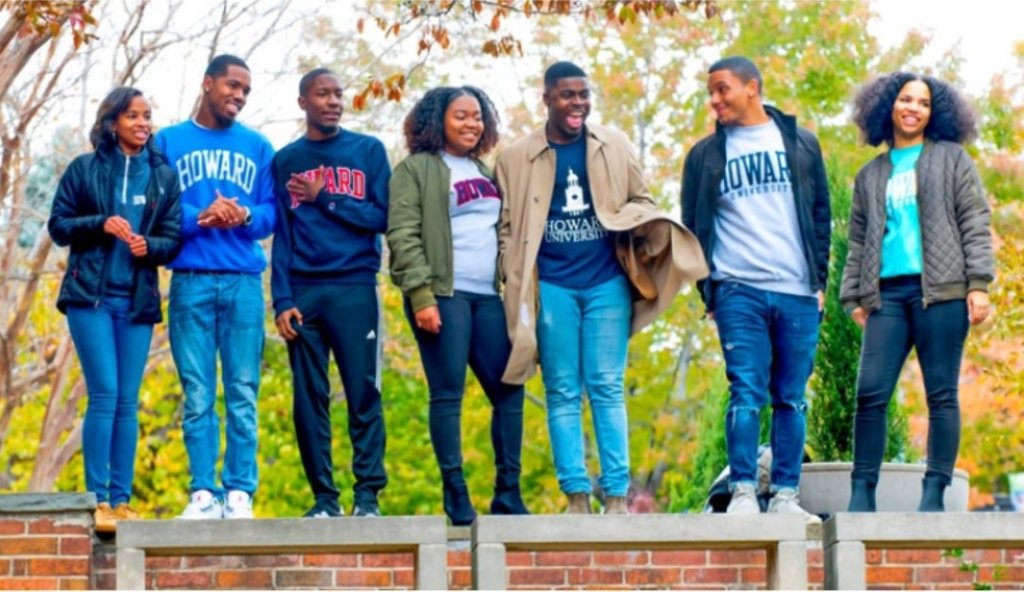
I found the photo on the HBCU Lifestyle Pinterest Page
A few weekends ago, my mom, sisters, and I took a little trip to celebrate my mom’s birthday. In the car we got into a conversation about Historically Black Colleges and Universities (HBCUs). I attended an HBCU in North Carolina, and made the comment that having attended an HBCU was one of the best decisions I’ve made. My mom wanted to know why I felt that way – but if you know me, you know that I’m not great with on the spot articulation of personal feelings. My mother’s memory of me being in college is probably centered on how much I hated North Carolina, and I did hate North Carolina. But I had decided in high school that I wanted to attend an HBCU and so much good came from that decision. Here are some of the things I experienced at my HBCU that makes me feel so grateful to have attended one.
Instructors Who Believed in Me
Looking back – I realize how much the instructors at my HBCU poured into our lives and academic endeavors. As someone who has spent time in the education world, I’ve seen first hand how our (Black) kids are sometimes viewed by non-Black instructors. Without certain teachers always knowing that I was listening in, I’ve heard otherwise sweet and friendly teachers say that “Black kids can’t learn, so don’t spend as much time on them.” I’ve known Black elementary school kids whose personal lives were hard and who were taking on way more responsibility at home than they should have been, only to come to school and be called an “asshole” (behind their backs) by the teachers who are supposed to be caring for them and investing in their lives. I’ve seen first hand both in my high school experience and as an adult how Black students get in trouble more often for the same offenses as white students – who generally didn’t end up getting in trouble (or in as much trouble) at all.
In my own educational experiences growing up, there were times that I felt singled out for things, stereotyped, and not taken seriously. On the flip side, there were also times where I felt that my instructors saw me as “better” than other Black students and gave me preferential treatment over my Black friends and classmates. Both experiences felt wrong. At an HBCU these types of experiences were slim to none. The instructors felt like aunts and uncles. They didn’t stereotype me. I didn’t constantly feel that my teachers were suspicious or afraid of me. And I didn’t feel that I was being treated as some kind of an “exception of my kind.” Often, they understood the educational baggage that students may have arrived with. Still, they held us to a high standard because they knew we were capable. I don’t think I have ever been “believed in” by instructors on a large scale as much as I was at my HBCU – and that includes the white instructors who taught there and personally expressed their belief in my intellectual capabilities.
Education Tailored to the Black Experience
The curriculum for students in the United States is very Euro-centric. It’s a logical and natural move – European descendants hold most of the power in this nation. Therefore the things that our nation values, teaches, respects, and innately understands comes from a Euro-centric point of view. I get that. But what happens is that if the stories of non-Europeans get told at all, they are always told from the view of Europeans. Almost all of the literature I read in school came from Europe or European descendants. In “World History” courses, we only talked about Europe. We spent (maybe) two weeks on the rest of the world and even that time was based on the European exploration of those places – not on those places as autonomous bodies. Any great achievements by mathematicians, scientists, philosophers all focused on European mathematicians, scientists, and philosophers. What ends up happening is that we are conditioned to believe that no other group of people made any lasting or positive contribution to the world. And if you happen to be part of a non-European group, you are un – (or under) represented in your educational journey which can lead to a low view of yourself and your place in the world, especially for Black people in diaspora who are already so disconnected from our heritage.
I’m embarrassed to admit it, but I didn’t realize how low of a view I’d held of Black people until I went to an HBCU. I had not ever seen Black achievement on a large scale, and thought for the most part that Black people were only really good as musicians or athletes. I didn’t realize, until college, that Africa had a history before slavery! I didn’t know much about Africa at all, honestly. I wouldn’t have been able to name many countries in Africa except Egypt, which I had only recently learned was in Africa prior to graduating High School. It was at an HBCU that I saw a full sized map of Africa for the first time. It was at an HBCU that we studied different African tribes and talked about pre-slavery African history – and it wasn’t an elective course – it was just part of a standard history class. But even when we did talk about slavery, we talked about it from the perspective of actual slaves who had lived through slavery. We read slave narratives and not just the narratives of abolitionists who may have worked for freedom and suffered as a result, but hadn’t experienced a life of slavery itself.
We also studied Asia, South America, and Australia – focusing a lot on the indigenous tribes that originated in in these places. It was a fuller representation of the world than what I had learned about in High School and that helped me to realize how much I had been conditioned to think only from one perspective.
The Chance to Sit With Black Thinkers/Professionals
I suppose this could happen at any college, but at my HBCU many of our visiting speakers were Black men and women who had accomplished a lot in their own professional lives. Cornell West came to speak at my HBCU – I think more than once while I was a student there. We also had other Black authors, lawyers, politicians, and scientists come who may not have been as well known but who’d had a lot of experience in their trade and were knowledgeable about how to overcome some of the institutional adversities that we face as people of color. For me, this directly pushed back against the stereotypes that I’d held of my own people as a teenager. And it wasn’t just the people who’d already “made it” that were inspirational. I saw many Black students who were doing big things on campus and in their pre-professional lives. It helped me to realize that we are fully human with a full range of interests, ideas, and passions. It helped me to realize that it is okay to be Black and intelligent, resourceful, compassionate, and professional without losing any of my Blackness.
The Opportunity to Feel Culturally Validated…
And speaking of Blackness – Black culture is extremely diverse, but I think there are still certain cultural norms that most Black people have in common with one another. All of it was accepted at my HBCU. I never realized how heavy of a weight it was to be the “token” Black person in most of my settings until I attended an HBCU and felt represented everywhere. I could be myself without worrying about whether or not I would be seen as promiscuous, threatening, angry, having an attitude, or less intelligent. The traditions of an HBCU – the sacredness of the yard, the divine 9 step strolls, the exuberance of the bands, among other things were upheld at my HBCU and felt completely natural although I had never been to an HBCU before my time as an HBCU student. The way our instructors related to us, told stories, explained concepts – all felt natural. The way the students related to one another, the jokes we told, the inflection in our speaking and our body language – even despite regional and global dialects or accents – all felt natural and easily understandable. Our extra-curricular activities were presented in such a way as to support and validate Black culture. I’m not sure I can adequately describe it except to say that it felt like I was home. I had never before and have never since felt as culturally validated as I did when I attended an HBCU.
…While Experiencing a Diversity of Cultures
Contrary to what you might be thinking, HBCUs are not just for Black people! While my HBCU was predominantly Black, I met and worked with students and instructors of different nationalities and ethnic backgrounds. Black culture was prominent, but it was not an exclusively Black place. Everyone was accepted and welcomed. The history behind the HBCU is that they were created to give Black students a chance at education during a time in the USA where quality education was not available to us. As a people who have suffered oppression in this country, it’s my belief that no Black person anywhere in the USA should ever inflict that same pain on anyone else. I think HBCUs in general feel the same. This isn’t to say that there might not be individual issues between two people, but institutionally speaking you are welcome. You are welcome if you are White, you are welcome if you are Hispanic, you are welcome if you are Asian, Middle Eastern – whatever you are, no one is going to be shut out. Make yourself known, and you will be validated at an HBCU precisely because we know what it is like not to be validated, not to be believed in, not to feel welcomed. And we aren’t trying to do that to anybody else.
As a result of some financial challenges, I ended up leaving my HBCU prematurely and was unable to finish my degree and graduate. At the time, I didn’t mind leaving because I really couldn’t stand the part of North Carolina that I was living in, my then-fiance (who was also my best friend on campus) had joined the Air Force and was no longer with me on campus, and I wasn’t certain of how much longer it would take me to finish school because I had changed majors. Looking back, I probably should have done whatever I could to try and stick it out even if just for the ability to spend a little more time in a safe space. If I ever get the chance to return to a physical campus to finish my degree, I’ll definitely be looking to attend another HBCU and would recommend HBCU attendance to anyone!
If you’re reading and you attended an HBCU, what was your experience?
 wholebrownsoul.com
Reading this, it reminds me that I wish I went to an HBCU for grad school. I would feel welcomed there. However, the HBCU in my state does not offer the program I wanted.
LikeLiked by 1 person