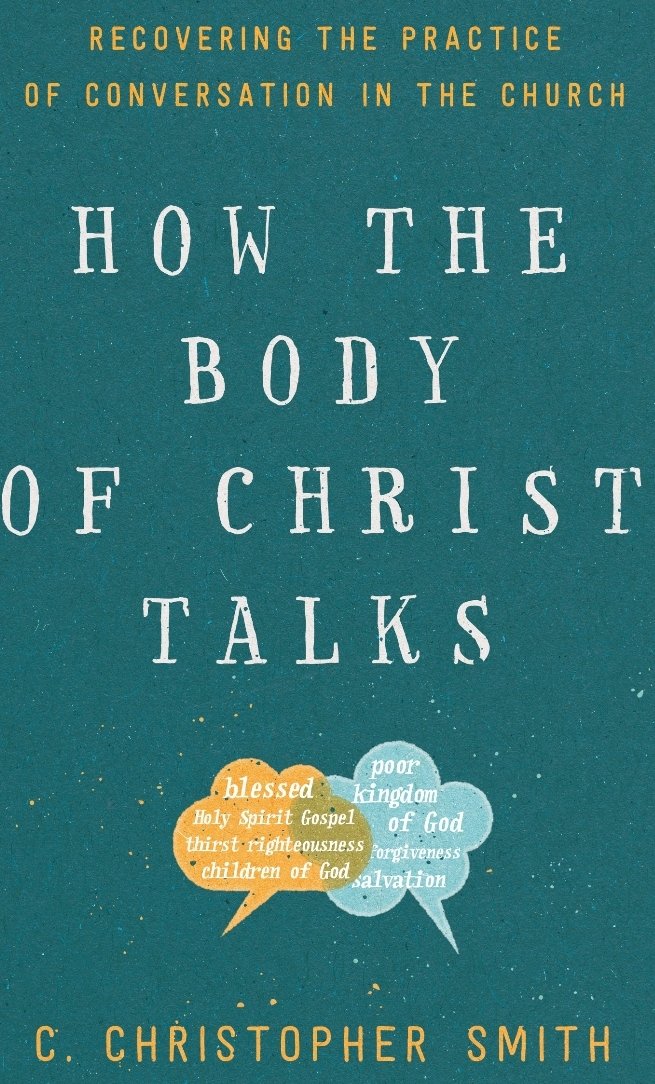
I’ve been slacking a bit – but I’m trying to spend some time writing about the four books I read this past summer. In September, I read a book called “How the Body of Christ Talks,” by C. Christopher Smith. As the subtitle of the book suggests, this book was about “recovering the practice of conversation in the church.” The book serves as a guide for how to have important and sometimes controversial conversations within a church setting – and how to minimize the fractures in community that often come with these types of conversations. I felt like this book was more than just about learning how to talk to one another – but about learning to live and strive together. I got a lot out of this book and if I had to rank the four books I read this summer, this one definitely makes the top two.
The first few chapters of the book read like a course on organizational leadership. They discuss why there is a need for conversation within the church and about different types of conversational methods that can be used with groups of different sizes and for various types of topics. It feels a bit more like the first few chapters are meant for people who are already in leadership positions, but people in non-leadership positions might enjoy having an inside look at the strategies used to guide the tough conversations and decision making processes that happen in group settings.
The next few chapters talk about prayer, silence, life’s chaos, and being present with one another through these things. There’s also some discussion on how to engage in conversation by reading relevant material (scriptures, quotes, articles, etc) beforehand and taking notes while listening. Christopher also talks about how to train your mind to listen well by tuning in to other things you might enjoy. Having regular habits like listening attentively to music, viewing art, meditating on poetry, or bird-watching can help train the mind to tune in more keenly, so that when we are engaged in conversation with others, those listening skills cross over. Even seemingly simple things like getting enough rest can help one to better process the information recieved in a conversational setting.
The last few chapters talk about how to develop a mission and an identity that centers around being conversational, how to persist fruitfully in conversation even when there is conflict, and how to arrange your personal life so that it supports being in conversational community.
There were three things that stood out to me the most as I read through this book.
The first thing is in chapter five. Christopher says “Although God has created us, and is ever present with us, God desires that we articulate our emotions in prayerful conversation. Our lack of transparency with God is often our way of resisting God’s transforming work in our lives.” I remember reading that line and thinking, “Hold up! Run that back!” I do a horrible job with articulating emotion in general, and I’m definitely not good at doing it in prayer. I know that God already knows what I’m thinking or feeling – better than I do – and so I don’t really bother to try to express complicated things to Him. I also “edit” a lot of my prayers because I don’t want to seem ungrateful, nor do I want to come off like I know better than God. I’ve never thought of that as “resisting God’s transforming work,” in my life, but maybe it is? I mean, just because Christopher said it doesn’t mean it has to be true, but I felt like it was worth thinking about more deeply.
The second thing that really stood out to me about this book was a story Christopher told in chapter six. The church that he’s part of used to have a large charity ministry – giving out food, clothing and probably other things as well. That all seems great, but Christopher describes his church at that time as “doing lots of things, but not reflecting much on how or where they were being done.” Despite all of the charity work, the church was not building meaningful relationships within the community it was part of. Christopher says this is because his church “didn’t know the neighborhood well enough to know that it was oversaturated with charities…” I think this resonated with me because I’ve been part of churches that started different ministries within a community but still didn’t feel like part of the community. It was just another church doing another thing. There’s a huge difference between offering a service as an entity that is “over and above” the community, and offering a service as an entity that strives together with the community. I think a lot of churches, perhaps unintentionally, say to the community – “You need us,” and not “We need each other.”
But you can’t strive together with the community if you don’t know it. Which brings me to the third thing that stood out to me from chapter 10.
I’d never thought about this, but a lot of churches are comprised of members who commute from outside of the community where the church exists. Growing up, my family was like this. We drove about 40 minutes each Sunday to attend church. We never ran into church members while we were out and about, I didn’t go to school with any of the kids who attended my church, and if we wanted to get together with people from church it had to be planned and organized in advance because not many of us lived close to one another. In other words, we really couldn’t be part of each other’s daily lives, nor were we part of each other’s communities.
Christopher advocates for being able to build better connections by actually being in the community where your church is located. I’m sure this isn’t always possible. But it helps to build stronger connections if your kids go to school together, if you can easily meet up for lunch or invite neighborhood and church friends out for dinner, or even if you’re just out grocery shopping and you happen to run into people from church who are also part of your residential community. Having that proximity does two things – it strengthens the friendships inside of the church – making the people at church feel more like part of your community and less like random people you see once a week. And it helps to strengthen the ties between the church itself and the community at large. In this way, you as an individual and your church as a whole can be most effective at loving the people around you. Which, for Christians, is really our one job.
After reading this book, I started noticing the differences between my church experience as a kid and my church experience in the past four years. Growing up, church was kind of a chore. We had to travel a bit every week to get there, we spent most of the day there, I didn’t have any friends there that I saw regularly or felt close to outside of the church setting, and overall church felt irrelevant to my everyday life. Now, we live five to seven minutes away from our current church and the people we attend church with are also the same people we see at the store, run into at the park, hang out with on a Friday or Saturday night, and go to school with during the week (I have two church kids in my class). It feels like my church community is integrated into the neighborhood community, which makes for a more holistic experience.
One last thing I really appreciated about this book is how it was organized. The book was split into three parts and the chapters within each part dealt with a different aspect of one topic. That helped the book to flow and I always appreciate a good sense of flow and efficiency.
I’m glad we read this one! If you’ve read it, I’d love to know what you thought.
 wholebrownsoul.com