Growing up in a Christian home, my initial ideas of God centered around God’s relationship with humanity. I was taught that God is an all-knowing, all-powerful, all-present father figure who wants to have an intimate, personal relationship with all people.
As I spent time studying various faith traditions, I began to feel that God is ultimately transcendent, uncontainable, and unknowable. I still believed in a God who was present in our personal lives, but I felt that God was less of a humanized “father in the sky” and more of a silent energy that subtly created, guided, and undergirded everything. I felt that I had encountered God in several of the faith traditions I’d studied over the years, and I could no longer see God only from the Christian perspective that I’d grown up believing.
At first, I didn’t quite have words for this new understanding of God. It wasn’t until my twenties – when I started to read the Tao Te Ching – that I realized how much Lao Tzu’s description of the Tao fit my own understanding of who God is.
I know that Lao Tzu is not necessarily talking about “God” when he writes about Tao. I think that Lao Tzu would probably say that the Tao is beyond being God or not being God. But there is still something about Lao Tzu’s description of the Tao that rings true for my experience of God and sounds exactly like the inexhaustibly expansive God I believe in.
I want to share some of Lao Tzu’s descriptions of the Tao here:
“The tao that can be described is not the eternal Tao. The name that can be spoken is not the eternal Name.”
– Tao Te Ching, 1
“The Tao is like an empty container: It can never be emptied and can never be filled. Infinitely deep, it is the source of all things. It dulls the sharp, unties the knotted, shades the lighted, and unites all of creation with dust. It is hidden but always present. I don’t know who gave birth to it. It is older than the concept of God.”
-Tao Te Ching, 4
“Look for it, and it can’t be seen. Listen for it, and it can’t be heard. Grasp for it, and it can’t be caught. These three cannot be further described, so we treat them as The One.
Its highest is not bright. Its depths are not dark. Unending, unnameable, it returns to nothingness. Formless forms, and imageless images, subtle, beyond all understanding.
Approach it and you will not see a beginning; follow it and there will be no end. When we grasp the Tao of the ancient ones, we can use it to direct our life today. To know the ancient origin of Tao; this is the beginning of wisdom.”
– Tao Te Ching, 14
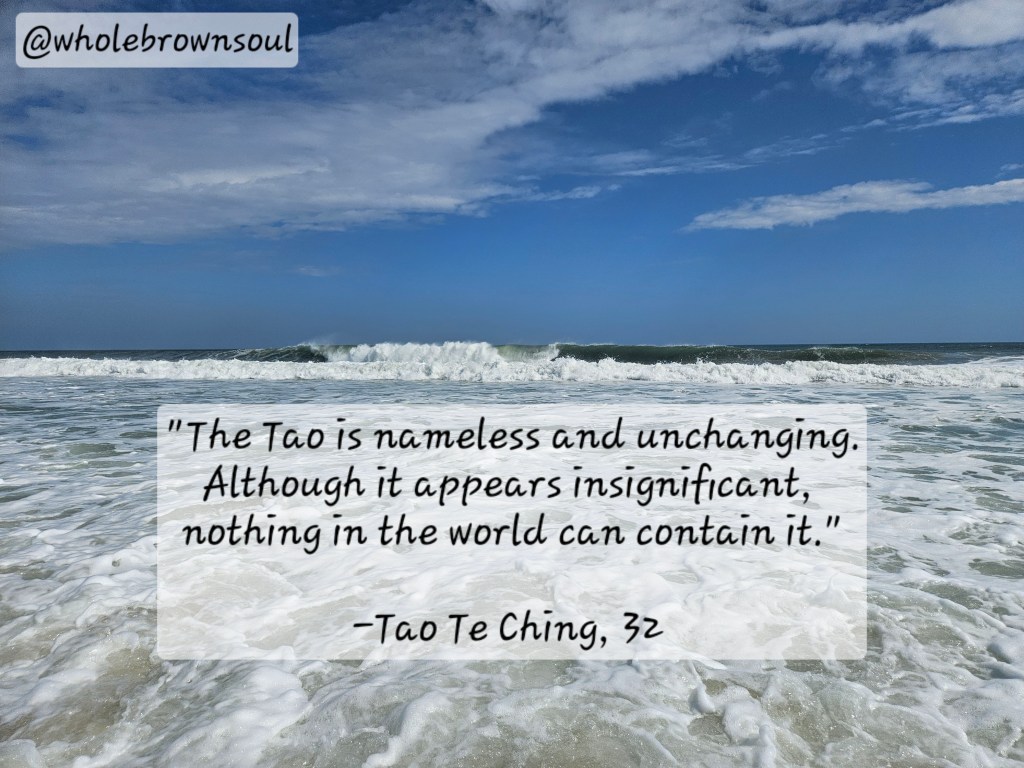
“The Tao is nameless and unchanging. Although it appears insignificant, nothing in the world can contain it.”
– Tao Te Ching, 32
These lines of the Tao Te Ching highlight the mystery of God’s nature. A God that is infinitely deep, like a container that cannot be filled or emptied. A God that is hidden, but always present. A God that benefits all of creation without the need to compete with it. A God that is the very source of all that exists, yet has no need for acknowledgment. A God whose heights are not bright and whose depths are not dark. A God of formless form, imageless image, no beginning, and no end. A God that can’t accurately be named or described ( though we still try), because in our grasping for God we lose the essence of who and what God is.
I will always feel that the Tao Te Ching gave voice to my experiences with God and encouraged me to lean into those experiences that ultimately manifested in my having an Omnist faith.
For the past week, I’ve been posting my favorite lines of Tao Te Ching on my Instagram, Tik Tok, and Facebook pages in a 30 Day posting challenge – #30DaysofTao. If you follow along on any of these platforms @wholebrownsoul (on Facebook – Whole Brown Soul), I’d love to hear from you about which of these lines of Tao stick out to you the most, and what meaning they might have in your spiritual life.
And if you have any spiritual or religious content you’d like to see, let me know and I’ll work on making it happen!

