A Diverse Upbringing
I grew up in a very diverse area. I always understood that my peers spoke various languages, ate different types of foods, and came from various places around the world. And although I’ve always been fascinated with spirituality, it wasn’t until middle school that I started talking to peers about their faith.
It was in middle school that I made my first Muslim friends. I also made acquaintances with people who were Jewish, Hindu, Wiccan, Roman Catholic, Buddhist, LDS -and a neighborhood friend of mine’s family was becoming Jehovah Witnesses. I regularly asked my friends questions about their religious practices. But the more my Muslim friends told me about their religion, the more attracted to it I became.
My Muslim friends became my best friends. They were the only ones who didn’t relentlessly tease me, as I’d been bullied all through elementary and middle school.
I loved that Islam had its own language, and the Qur’an was the most beautifully decorated book I’d ever seen. I loved hearing words like “Insha’Allah,” or “Subhan’Allah” inserted into sentences spoken by my Muslim friends. I’m a bit of a linguophile, and these linguistic touches made me feel warm inside. I loved how Islam was so organized, efficient, and easy to understand. It was straightforward, which made it tangible.
An Eid Experience
One evening, I was invited to an Eid party at a friend’s house. I’d asked so many questions, and I guess they figured I’d be interested in a first hand experience.
It was at the Eid party that I saw Muslim prayer for the very first time. This is a moment that struck me to my core and has always stuck with me. I was used to a type of prayer where a person rattled off whatever they wanted to say, for however long they wanted to say it. Sometimes these prayers were more for show than they were for actually communing with God. Sometimes these prayers felt empty afterward. After all the emotion died down, then what?
But Muslim prayer was different. It was organized, it was scheduled, it included movements that demonstrated the words that were coming out of one’s mouth. Standing, sitting, prostrating – the prayers felt less like reciting a wish list and more like coming into sacred remembrance. Before prayer, people washed their bodies and the inward reflective practice of making sure one’s heart is clean before prayer was outwardly shown in wudu – the washing of one’s hands, feet, face, and mouth.
Muslim prayer felt peaceful, pure, reverent, and unifying. It remains one of the most beautiful religious experiences I’ve ever had.
Throughout the night, I had the chance to ask genuine questions and have them answered without judgement. I had a chance to read the Qur’an. And I got to hear the story of how my friend’s mother had converted from Catholicism to Islam.
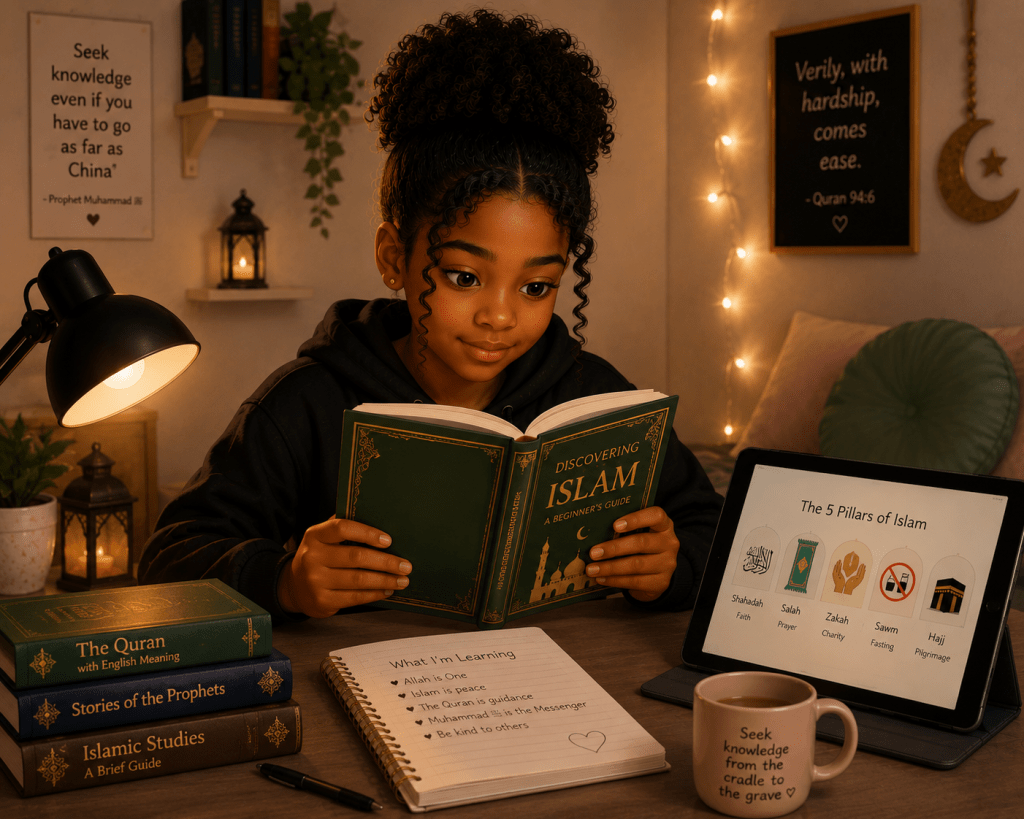
I left this experience seriously contemplating whether I should look into becoming a Muslim. I went to the bookstore and bought Huston Smith’s “World Religions.” I was eleven or twelve years old, and it was my first religion textbook. I talked to my Muslim friends about Islam all summer long. At the library, I read the Qur’an and conversion stories in the book “Daughters of Another Path,” by Carol Anway. The internet was new, and I learned how to log onto Muslim websites run by Muslim women. My friends supplied me with tapes of khutbas (sermons) and nasheeds (Muslim songs).
I learned so much about the Muslim faith between my sixth and seventh grade years, that by the eighth grade – I was ready to convert. Or revert, as a Muslim would say.
Conversion
I converted to Islam on the phone (remember threeway?) with a friend of mine and the wife of an Imam. I remember saying the confession of faith, “La ilaha il Allah, Muhammad ur rasul Allah,” or, “There is no God but God, and Muhammad is His messenger.” Making this confession made me a Muslim. The Imam’s wife said to me, “Now, your slate is wiped clean!”
It felt good to be able to say that I was a Muslim, even if only to myself. I kept it a secret, at first. I would meet with my friend at the library, and she would teach me how to pray. As I learned to pray and live like a Muslim, I can say that I felt more grounded than I’d ever felt in my life.
The world seemed brighter. The sky was bluer, trees were greener, I could feel the wind blowing on my skin and take in the fresh air with what felt like a deeper lung capacity. I felt at home. I had a community. I had tangible practices – Salat, Ramadan, Hijab, Qur’anic recitation and memorization. I was learning Arabic. I had taken on the Muslim name Khadijah.
I experienced God in a completely new way as a Muslim.
Something about the Muslim faith felt – for me – tangible in a way that I couldn’t quite articulate.
Muslim Life
Most people in my life did not see my conversion to Islam as authentic. I’m not sure when or how I came out as a Muslim, but it wasn’t taken well.
At school, specifically when I started to wear hijab, I was made fun of. I often was taunted with chants of “fake Muslim” and other insults as I walked through the halls or into classrooms. This was made worse one day, when my parents went into my room and took all of my Muslim books, tapes, and hijabs away. I had to go to school without my hijab, which made the kids at school feel even more correct in their assumption that I had only been faking my Muslim faith. The teasing increased. I wasn’t allowed to spend time with my Muslim friends and, because they were my only friends, the isolation was hard for me.
What no one understood was that I wasn’t “going through a phase,” or “trying to find myself.” Islam was logical, devout, simple, and offered a groundedness that I’d not felt before. It was tangible – a word I have often used to describe the faith. And it was beautiful. Despite all of the ridicule, I loved being a Muslim.
My time as a Muslim was tumultuous and isolating. My family did not support my choice to convert to Islam, and it seemed like my desire to practice the faith contributed to the already strained relationship I had with my family. I wasn’t allowed to spend time outside of school with my Muslim friends – and I didn’t have any other friends to spend time with.
Leaving Islam
Once I got into high school, I was redistricted away from my Muslim friends. Since I was not allowed to talk to them outside of school, we lost touch. It was too hard to remain a Muslim in a home that was actively against my practicing Islam – and so I gave it up. I thought that I would return to Islam when I turned eighteen, but as I grew into adulthood, I realized that there were other factors that prevented my re-joining Muslim community.
Reflecting on my Experience with Islam
The experience of being a Muslim impacted me deeply, though. It taught me that God can be found anywhere. It taught me that there is more than one way to have, understand, interpret, and honor spiritual experience. It taught me that truth is truth, wherever you find it. It taught me the impact of history, culture, language, and heritage on religious belief.
It taught me that I could let go of the boxes I was taught to put God in, and learn to view God and spirituality panoramically.
And although I’m no longer a Muslim, Islam will always have a special place in my heart.
“Quoting Qur’an” on Whole Brown Soul
Over the next four weeks, I am reading through the Qur’an again and posting the verses that resonate with me on my social media (@wholebrownsoul on Instagram, Tik Tok, and Facebook) and here on the blog. If you’ve ever been curious about what the Qur’an says – or if you’re interested in an Omnist take on the Muslim faith – follow along and explore the Qur’an with me!

