As I did with Tao Te Ching, I have been posting quotes from the Qur’an on my social media pages for the last few weeks. The Qur’an is much longer than Tao Te Ching, so I’ll definitely have to return to the Qur’an at some point to continue posting the scriptures that stand out to me. In the meantime, I want to elaborate on the scriptures I’ve already posted.
In the Qur’an, verses are called ayat (plural) or ayah (singular). One of the most powerful verses in the Qur’an is called “Ayatul-Kursi” meaning “Verse of the Throne.”
This verse is a description of the absolute nature of God’s sovereignty and is considered to provide spiritual protection against evil. My first post in the Quoting Qur’an series came from the first lines of this verse.
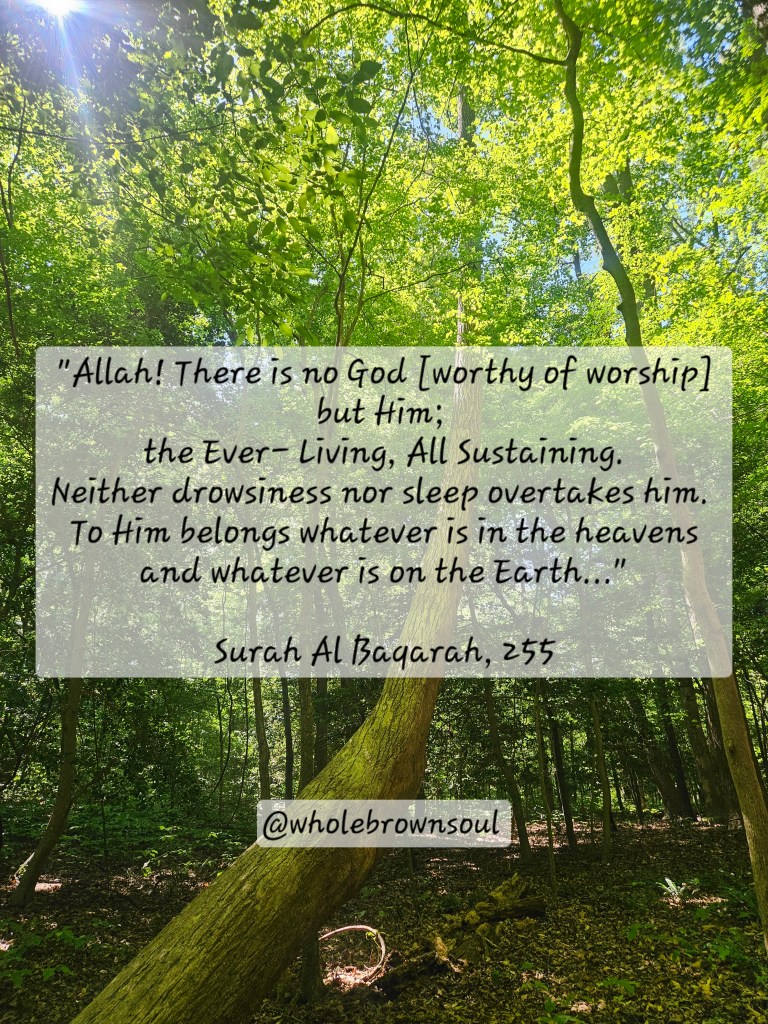
Islam is a strictly monotheistic religion. Idolatry, or shirk, is a grave sin that some believe is unforgivable (more about that in another post). In converting to Islam, one confesses that “There is no other God but God…” and Ayatul Kursi reinforces this in its opening sentence.
Not only is God the only God, but God lives eternally and sustains everything that exists. God does not get tired or fall asleep, and everything that is in the heavens and on the earth belongs to God.
The verse goes on to describe God further.
“Who could possibly intercede with Him without His permission? He [fully] knows what is ahead of them and what is behind them, but no one can grasp any of His knowledge – except what he wills [to reveal]. His Seat encompasses the heavens and the earth, and the preservation of both does not tire Him. For He is the Most High, the Greatest.”
In Islam, we do not need intercessors to go to God on our behalf. God already knows things about us that we do not even know about ourselves. And whatever we do know, is only known by us because God allowed us to know it.
In Islam – God is the only one of His kind, has ultimate authority, sustains everything, and never tires. For some, this idea of an all-encompassing God is comforting. For others, it’s off-putting.
When I was in middle school and converting to Islam, I remember the absoluteness of God being one of the things that drew me in. Having grown up in the Christian faith, I’d been taught that Jesus is an intercessor between God and myself. And there were other Christian denominations that viewed Saints as intercessors. I wondered why such a powerful God would need any intercessors. Even in the Jewish faith, from which Christianity descends, God declares Himself to be the one and only God.
This type of God’s oneness simply made more sense to me, at the time.
What do these ideas of God’s oneness make you feel? Does it encourage you to know that there is one God who knows all about you and watches you at all times? One God that you can go to for everything? Or is that idea limiting and unrealistic to you? I would love to know your thoughts on the nature of God!


One thought on “Quoting Qur’an: Surah Al Baqarah, 255”