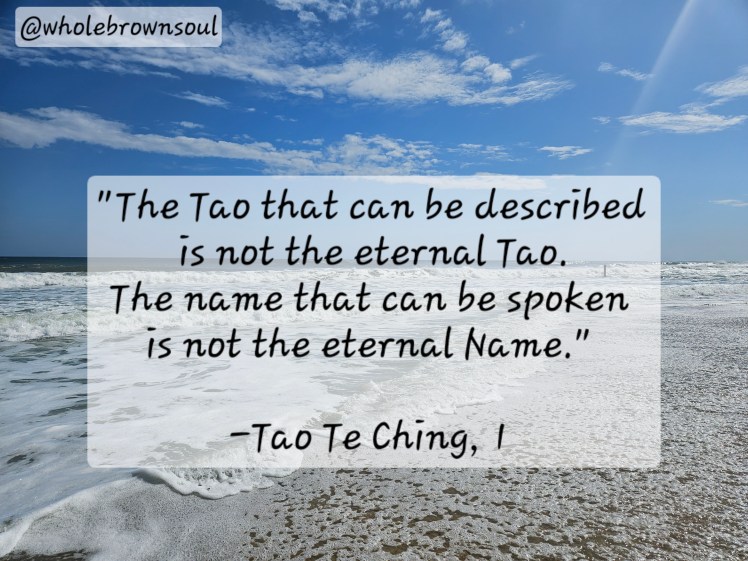
These opening lines of the Tao Te Ching grabbed my attention the moment I read them.
I remember standing in the bookstore, curious about what this little book contained. I had read a bit about Taoism as a pre-teen, but it confused me, and in my twenties, I wanted to know more.
I didn’t get to read much before my then-partner took the book out of my hands and told me I should only be reading the Bible. But these first few words of the Tao Te Ching stuck with me for a few years, until I was able to read it again.
These lines set the tone for the rest of the text. The Tao, or the way, cannot be described. To describe it is to limit it. To name it is to put it in a box. The Tao Te Ching’s author, Lao Tzu, spends much of the text “undefining” the Tao to express its all-encompassing and yet nearly imperceptible nature.
I think what I love most about this verse is its transcendence. The idea that there is an eternal way that cannot be described, named, or defined – and yet it is so unbounded that it gathers and binds everything else together.
Although Laozi was not necessarily talking about God, I feel his words are the words I would want to use to talk about God.
A limitless being whose transcendence somehow brings order and flow. An infinite universe that is part of us, and we are part of it. An eternal way that is unnamed and ineffable. A truth that is elusive and yet ingrained deep within us.
These lines also form the basis for my Omnist practice. As an Omnist, I believe in the validity and truth of all faith traditions while also holding that no one faith tradition could ever contain absolute truth.
When we rigidly hold onto our ideas of what truth is, we can lose truth. When we rigidly define and package our spirituality – we can lose the essence of our spirituality.
The limitless nature of the Tao means that it can be reflected in everything – and everyone.
To me, nothing is more Omnist than that.
 wholebrownsoul.com