One of the things I love most about the Tao Te Ching is the humility the Tao is described as having. For those of us who come from an Abrahamic faith, we might be used to a “jealous” God who seeks glory and honor for Himself. We might be used to a God who damns us to hell for believing in the wrong faith, or a God who doesn’t hear our prayers if we have not fallen in line with His ideals. And yet, this same God instructs us to be humble and gracious.
Here is what the Tao Te Ching says about the Tao:
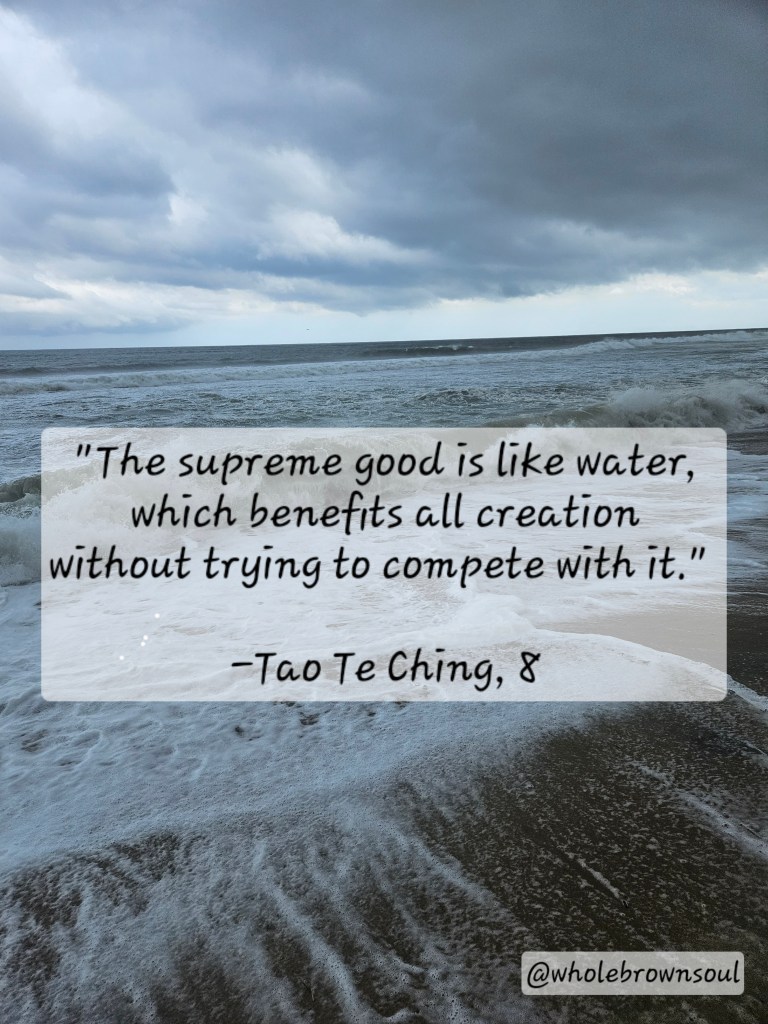
“The supreme good is like water, which benefits all creation without trying to compete with it.” -Tao Te Ching, 8
“Giving birth and nourishing, making without possessing, expecting nothing in return. To grow, yet not to control: This is the mysterious virtue.” -Tao Te Ching, 10
“When it [the Tao] has accomplished great wonders, it does not claim them for itself. It nourishes infinite worlds, yet it does not seek to master the smallest creature.” – Tao Te Ching, 34
“The highest good is not to seek to do good, but to seek to become it.” -Tao Te Ching, 38
“Those who are good she treats as good. Those who aren’t good, she also treats as good. This is how she attains true goodness.” -Tao Te Ching, 49
We live in a world where, so often, people do the right things in order to be recognized, rewarded, or from fear of punishment. The motivation for goodness is sometimes selfishness. And that is not goodness at all.
I believe in a God (or a way, or a source, or the universe – whatever you want to call it) that is good for goodness’ sake. Not seeking recognition, not seeking power or honor – a God who is good simply because good is It’s identity.
And I want to be that kind of good, as well.
I want to cultivate a way of being that is beneficial and adds value to every life I interact with – without requiring anything in return.
And I want to exist as goodness in this world, as much as possible.
 wholebrownsoul.com