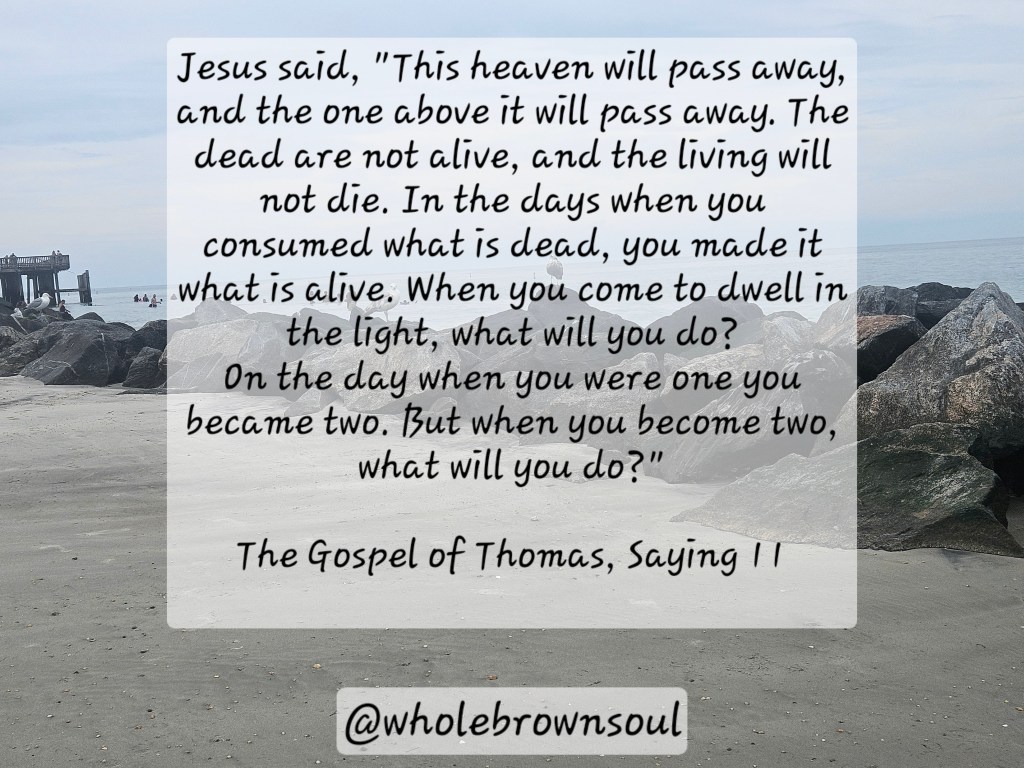
I posted this saying to my social media yesterday, and I used that trending “saxophones getting louder” sound in the background, because this is one of those verses that starts off normally but becomes more and more chaotic as you read it. I spent a lot of time thinking about what it could mean, and I definitely wanted to explore it more here on the blog.
“This heaven will pass away, and the one above it will pass away. The dead are not alive, and the living will not die.”
Saying 11 starts off normally, with Jesus saying normal ‘Jesus’ stuff. From a canonical Christian lens, it reminds me of Jesus saying that “Heaven and earth will pass away, but [His] words will never pass away” (Matthew 24:35). And then Jesus goes on to say that the living will never die – which seems to echo Jesus’ promise that whoever lives by Him will never die (found in places like John 8:51 or John 11:25-26).
But then it gets weird.
“In the days when you consumed what is dead, you made it what is alive.”
I was intrigued by this line because I had no idea what it meant or how it connected to the line before it. I wondered if it carried a wholly spiritual meaning or if it also had a physical meaning.
To give some (potentially?) relevant context, Jesus’ companions were asking him (in Saying 6) about how they should fast, pray, and about dietary laws. Jesus responded by saying that the lion whom the man conquers is blessed, and the man whom the lion conquers is cursed.
Spiritually speaking, I wonder if this line about “consuming what is dead” refers back to Saying 7, “Blessed is the lion which becomes man when consumed by man…” My interpretation of that line was that the lion represented negative traits that “seek to devour” us (see 1 Peter 5:8). When humans consume (or conquer) these negative traits, they can become positive qualities that are used for good. For example, a person who was once a good liar can use their persuasive capabilities to inspire others to do good.
Physically speaking, I wonder if it refers to the dead animals and plants that we eat. When our food becomes part of us – in a way – it lives again. It becomes part of the vast system of our physical network and provides nourishment for bodies that are alive.
“When we come to dwell in the light, what will we do?”
This question seemed rhetorical, to me. If dwelling in the light means physical death, we won’t need food. If dwelling in the light refers to spiritual enlightenment while physically alive, then perhaps Jesus is asking this rhetorical question to guide how we live. Almost as if one is faced with a decision and asks themselves, “What decision should I make as a person who is dwelling in the light?”
“On the day when you were one you became two. But when you become two, what will you do?”
Here we are again with a line that doesn’t seem to connect to the lines before it, and another rhetorical question at the end. But this question feels more like exasperation to me. Jesus almost seems to be lamenting that we were once “one” and then became two.
I understood this to mean that at some point we were one with our divine nature and fully aware of who we are at our core. But somewhere along the way, we became inwardly divided. Our default spiritual nature became clouded by the physical and material world in which we live.
Now, our spiritual and physical natures compete for our attention.
Again, Jesus asks what we will do. As it stands, we are divided within. Will we return to our spiritual nature? Will we return to dwelling in the light? Or nah?
Final Thoughts
If Saying 11 is part of Jesus’ response to the question of how we should pray, fast, and eat – then I think Jesus may have been calling on his companions to practice their rituals in a way that reflect inner wholeness and spiritual cultivation.
To me it feels like Jesus is saying, “Observe your rituals however you want. This world is disappearing, anyway. And if you are not spiritually alive, you’re going to disappear with it. You worry about the physical things – like what dietary rules to follow – but when you are dwelling in the light, you won’t even need food. Your need for food is temporary. Worry more about your spiritual diet – conquer the things that keep you from spiritual alignment. Your need for spiritual alignment is eternal. It saddens me that humanity has forgotten its true nature and become divided within and without. Are you going to return to your true selves?”
Please keep in mind that I am not an expert on Gnostic literature and this is only my best guess as to what these verses mean. On the other hand, I don’t think the purpose of the Gnostic writings is to know exactly what they mean with our intellect. I think the purpose of them is for us to pause to reflect and ponder their meaning in light of our own experiences, understanding, and spiritual capacity.
What stands out to you from Saying 11 of The Gospel of Thomas? What do you think it could mean?
I’d love to talk more about it!

