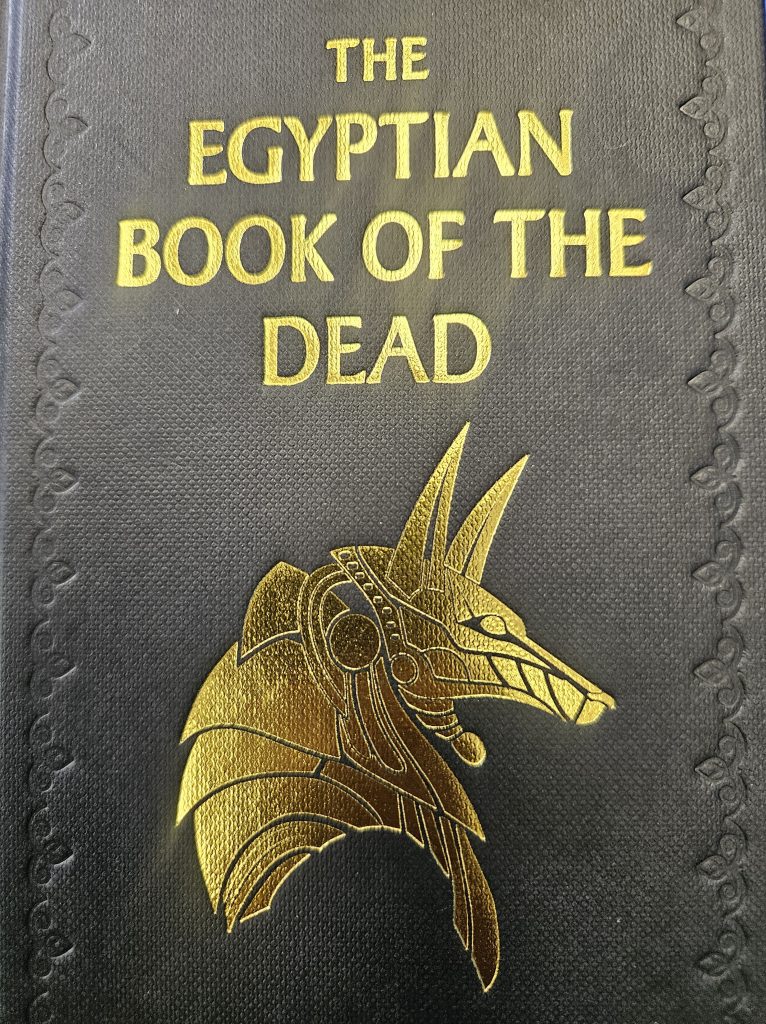
I remember hearing about the Book of the Dead when I was younger, and thinking that it was a book about demons, evil, and hell. There probably wasn’t anyone in my life who’d actually read it, so there wasn’t anyone who would have been able to tell me anything different. I ran into a cheap copy of it at Five Below – a sort of condensed version – and I bought it with the hope of understanding more about ancient Egyptian religion.
Something that has always bothered me is that as a Black woman, the spiritual practices and beliefs of my ancestors were likely stripped from them and replaced with Christianity when they were brought to the United States. It has always made me feel so sad to not have a concrete “home” to refer back to. Africa is a large continent with many different indigenous faith systems, but my ancestors would have been clumped together as one group and their heritage lost as they were forced to assimilate.
As I have explored different religious beliefs over the course of my life, I naturally became curious about what my ancestors might have believed. The two largest African originating religions that are known around the world are Ifa and Ancient Egyptian religion. I have studied these faiths to some extent in the past. But I want to them in more depth as a way to honor what little I can of my known heritage. I figured reading The Egyptian Book of the Dead would be a good start.
“The Egyptian Book of the Dead” is not about demons, evil, or hell. Rather, it is a collection of hymns, poems, and spells to help guide a person through the afterlife once they have passed on.
One of the new things I learned was that ancient Egyptians believed that humans are comprised of different parts that dissipate at death. The khat or physical body, the ib or heart, the ren or name, the shut or shadow, the ka or life force, and the ba or spirit. The mummification process was meant to keep these parts together so that a person could transform into their spiritual form.
It was believed that after death, a person’s heart would be weighed against a feather. If the person’s heart weighed less than the feather, the person would be able to pass through to a peaceful afterlife. If a person’s heart weighed more than the feather, however, that person would be eaten by the devourer, Ammit.
The feather represents Ma’at, or the cosmic order, which I will write more about in another post. There are 42 laws of Ma’at that revolve around being peaceful, compassionate, working hard, being just, being honest, and being wholesome. A light heart keeps one from being devoured.
I find it interesting that no matter where you are in the world, and no matter what time period you’re in, there are similar notions of what constitutes an acceptable lifestyle. People who are peaceful, compassionate, just, and honest are almost always regarded as good.
As humans, we know what is good because it is inherently within us.
I can’t wait to learn more about “The Egyptian Book of the Dead,” and more about Kemeticism.
I hope that you’ll join in!

