When I was in elementary school, I lived in an abnormally diverse area where I had the opportunity to meet people from all different types of cultures, religions, and linguistic backgrounds. One of the things that was really difficult for me, as a child, was this feeling of not having a strong heritage that could be traced. I didn’t have a concrete “homeland” where I could trace my ancestors hundreds of thousands of years back. I spoke English, and nothing else. I didn’t have any cultural differences in my life that I felt (at the time) were unique or that stood out. I think as a young child, this was what set me on the path of studying languages and religions at an early age.
As I got older and learned more about African American heritage, I began to take more pride in my Black ancestry. And I found myself asking questions about what sorts of faith traditions my pre-colonial ancestors might have practiced.
Although I do not know of any Egyptian heritage in my blood line, because Egypt is on the continent of Africa, I began taking an interest in faith traditions that originated in Egypt and faith traditions that were influenced or interpreted through an Egyptian lens (for example, Egyptian Muslims or Coptic Christianity).
It was looking into Egyptian faith traditions that led me to Ma’at.
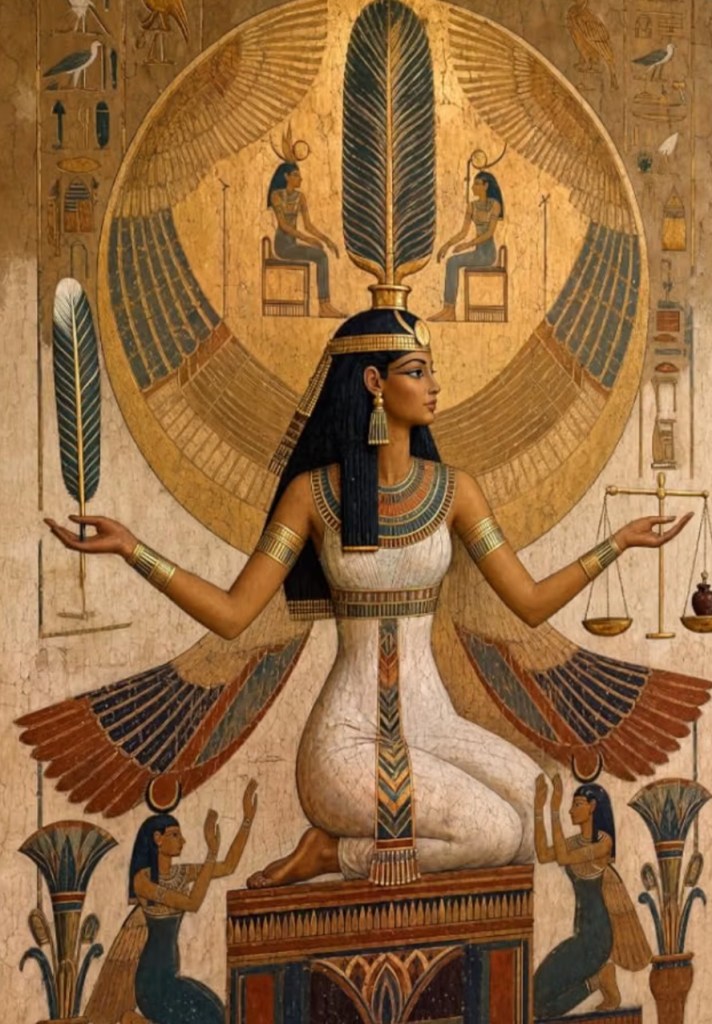
Ma’at is the goddess of truth, balance, and cosmic order. She is not only a goddess, but she is the personification of these ideals. I tend to think of her in the same way that the Bible personifies Wisdom.
Ma’at has seven principles. Truth, Justice, Harmony, Balance, Order, Reciprocity, and Righteous Conduct. The opposite of Ma’at was Isfet – or Chaos. The Pharaoh was charged with keeping these principles and setting the tone for these principles to be kept within society. It was believed that a person who passed into the afterlife would have their heart weighed against Ma’at’s feather – and would only be allowed into the peaceful realm of the afterlife if their heart was lighter than the feather.
Ma’at’s husband was the god Thoth. He was considered to be a god of intellectual pursuits. He is present as a scribe during the weighing of the heart and his domain included wisdom, magic, the moon, writing, and judgement. These two gods are paired together, perhaps, as a way to show that intellect is no good without morality. And morality without intellect can also be just as dangerous.
Ma’at has 42 negative confessions. These are 42 violations that a person can confess to not having done. A person who is able to confess to not having done these 42 things was said to be an innocent person. These negative confessions have been re-written to suit the modern reader. In another post, I’ll talk more about them.
One of the reasons that Ma’at resonates with me so much is because she is an indigenous African goddess. Another reason that she resonates with me is because I admire the principles of truth, justice, harmony, balance, order, reciprocity, and righteous conduct. These principles are important to me in my everyday life and I strive to live by them. I admire Ma’at and am drawn to her as both a personal entity and as a representation of what is good. As an Omnist, I believe that all truth is from God. So whether Ma’at is a real goddess/entity or not, she carries God-like qualities that I respect.
As an Omnist, I think the Fall season is the perfect time to go on a bit of an exploration of Ma’at and her principles. Fall is a time of dying. Not the literal death of a person, but the death of old things so that new things can spring forth in the coming months. In Judaism, Rosh Hoshannah (which happens in the Fall) is the “head of the year,” and in the ten days that follow, our fate for the year is sealed. This makes fall a great time to think about ways in which we can strive for truth, justice, harmony, balance, order, reciprocity and righteous conduct in the coming year. In the Hindu faith, Diwali is celebrated in the Fall – a celebration of good over evil and light over darkness. A celebration of all that is true, just, and harmonious in the world. In Pagan practices, the Fall is a time where day and night are briefly equal – representing balance. In Christianity, fall is a time of harvest which could represent the reciprocity of “reaping what you sow.” There are also Christian traditions that call us to reflect on our mortality during the autumn season – and because Ma’at was believed to be a judge of hearts at the passing of human life – it fits to reflect on her principles at this time of the year.
I’m looking forward to learning and writing more about Ma’at this season.
Have you ever been drawn to gods or goddesses outside of your spiritual tradition? Who were they and what about them drew you in?

