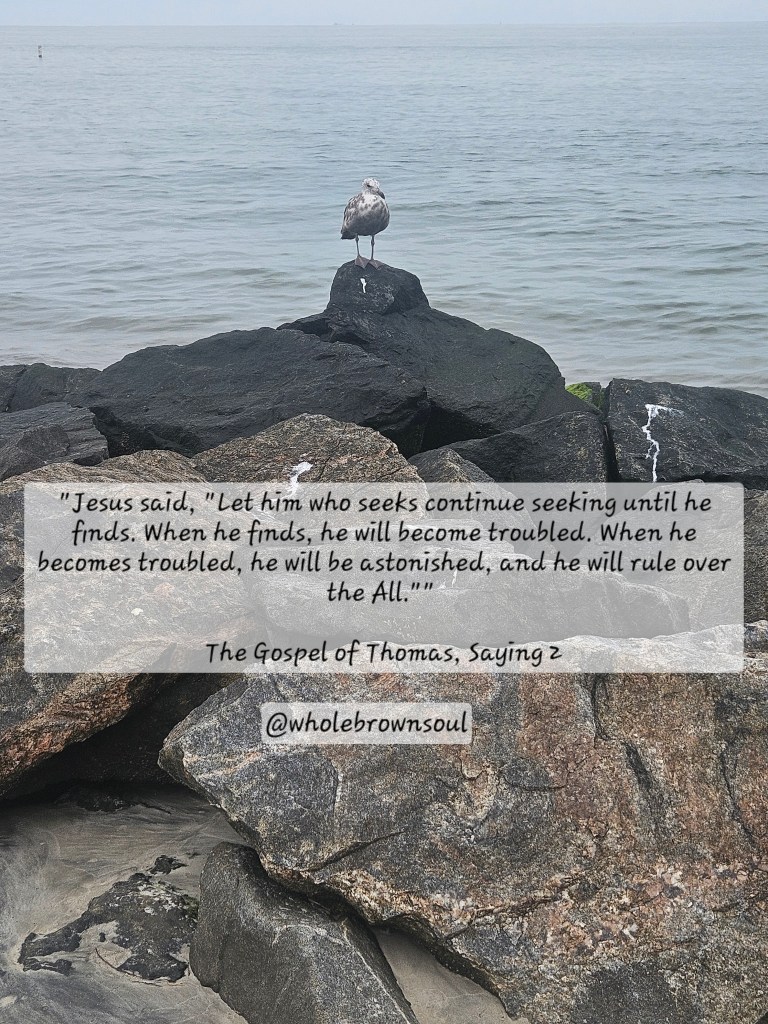
I’m new to Gnostic literature. This is one of the very few spiritual paths that I never explored. Growing up, I’d heard warnings against Gnosticism but never quite knew what it was. And surprisingly, never looked into it.
It wasn’t until a few weeks ago when I saw three nearly back-to-back posts by three people from very different religious backgrounds each asserting the same Gnostic belief that I decided to do a bit of investigating. That’s how I found The Gospel of Thomas.
The Gospel of Thomas is composed of things Jesus said to his disciple, Thomas. These sayings didn’t make it into the Bible for various reasons, but there are sayings that echo or expound on Jesus’ Biblical sayings.
As I did with Tao Te Ching and the Qur’an, I’m spending the month posting the lines that stand out to me on my social media pages and elaborating more on the blog.
Most of the sayings in The Gospel of Thomas are meant to be puzzling, sort of like Buddhist koans. The goal is to sit with each passage and reflect or meditate on it until you come to some sort of deeper understanding of what it means. Here is the second saying of Jesus, according to the Gospel of Thomas:
“Jesus said: ‘He who seeks, let him not cease seeking until he finds; and when he finds he will be troubled, and when he is troubled, he will be amazed, and he will reign over the All.””
Although I am certain there are other interpretations than what I’m about to give, this line didn’t feel like much of a mystery to me. Anyone who has ever deconstructed their faith would probably understand it readily. It seems like Jesus is encouraging those who are seekers to continue their search for truth, wisdom, enlightenment, and spiritual understanding. But the search comes with some pitfalls.
If you’re a person who has ever challenged your own belief systems – you’ll understand that the more you search for truth, the more (temporarily) tormented you’ll find yourself. There’s something about facing your own belief system and asking, “But what if I’m wrong about all of this…?” that either terrifies or excites us.
For those who are terrified, they might stop searching and return to their old ways. And that’s okay, a person can only go as far as their window of tolerance allows. For those who are excited by the prospect of being wrong – there is still a bit of trepidation. We don’t know where our search will lead or what it will cost us. We may end up isolated, outcasted, and unfairly labeled or perceived. We may learn things that disgust us, terrify us, shock us, hurt us, or make us feel ashamed. Our trust in the world we knew may break. And there is no one with whom to discuss our new knowledge – because the people you’d normally talk to may not believe the same truths that you have found.
But as we press on in our search, we find ourselves astonished by what we discover. We find ourselves freed. We find ourselves feeling lighter, happier, more grounded, more present, and more aware. And it is at this point that we begin to rule over the All.
I’m not sure what is meant by “the All” in the Gnostic texts. I don’t yet know enough about Gnostic cosmology or philosophy to make a good guess. I can only assume that the All refers to our inner worlds.
From a place of freedom, groundedness, and peace – we find that we are able to control our inner realities, which in turn will define our outer reality.
While taking a walk with my girlfriend, we talked about what “the All” might mean, and her interpretation was that one conquers their fears. Whatever you are afraid of, ultimately controls you. And it is often fear that keeps people stuck in rigid beliefs, patterns, and behaviors. This fear might be what troubles us, but as we press on, we can become astonished by our ability to step outside of fear and truly live from a place of clarity. It is at that point that we have conquered “the All.”
I’m looking forward to learning more about Gnosticism, The Gospel of Thomas, and other Gnostic writings as time goes on. Have you ever experienced a time in your life where your entire belief system was challenged? At what ultimate conclusions did you arrive?

